Note Instruments
Badges that know when they were last used
A stack card and service badges, drawn as SVG by one Worker, from the same reading that ranks the stack on the front page.
Most README badges are decoration: a shield with a number somebody typed once. These are a projection of a record. The nightly job re-measures which services are actually in use, and the picture in a README changes without that repository being touched.
What it looks like
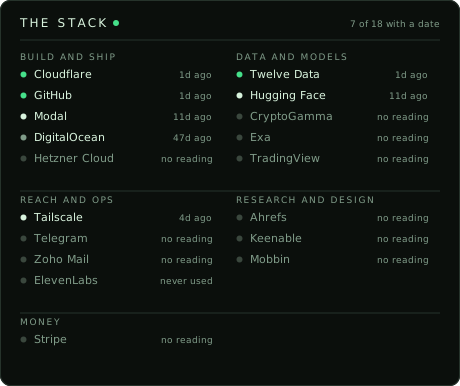





Live, not a screenshot. Come back tomorrow and the ages have moved.
Copy it
Three lines, any README. The card wants a wider slot, so it sits on its own line.
<a href="https://pAulseperformance.com/#stack"><img
  src="https://pAulseperformance.com/card/stack.svg"
  alt="The stack: services ranked by when each was last used" width="460"></a>

<img src="https://pAulseperformance.com/badge/stack.svg" alt="the stack" height="28">
<img src="https://pAulseperformance.com/badge/cloudflare.svg" alt="Cloudflare" height="28">
Any service in the strip works: /badge/ plus its name, lowercased with dashes. twelve-data, hugging-face, zoho-mail. A name that is not in the strip answers 404 rather than inventing one.
What it is reading
One JSON object in KV, written every morning at 07:05. Each service carries a band and the sentence that proves it: the newest hour with Worker traffic, the newest deploy, the newest invoice period, the newest call our own tools logged. The band comes from the date, never from the sentence.
{
  "schema": "portfolio.stack/1",
  "generated_at": "2026-11-16T19:00:41Z",
  "chips": 18, "quiet": 11,
  "groups": [
    { "title": "Build and ship",
      "chips": [ { "name": "Cloudflare", "band": "hot",
                   "said": "last used 2026-11-16 · the newest hour with Worker traffic" } ] }
  ]
}
The five bands
| Band | When | How it is drawn |
|---|---|---|
| hot | used in the last 3 days | accent ring, a dot, bold name |
| warm | this month | solid ink |
| cool | older | muted |
| none | no reading at all | faded dot, the words "no reading" |
| dormant | never used | faint, "never used" |
Drawing none at all is the useful part. A badged list that shows only what works is a brochure; the gaps say which integration nobody can measure, and that number should fall as instrumentation improves.
Run it yourself
The whole thing is a route, a KV key and a template. No build step, no image pipeline, nothing to keep in sync.
// the route
if (url.pathname.startsWith("/badge/")) {
  return stackBadge(env, url.pathname.slice(7).replace(/\.svg$/, ""));
}
if (url.pathname === "/card/stack.svg") return stackBadge(env, "stack", "card");

// and inside stackBadge: one KV read, one template, one response
const raw = await env.CV.get("stack:activity");
return svg(cardFor(JSON.parse(raw)), 460, height);
Two rules keep it honest. The band is decided once, in the code that writes the JSON, so the page, the card and the badge cannot disagree. And a reading that loses dates while the service list stays the same is held: the writer compares against the last reading it published and refuses, because a probe that stops answering does not unmake the day you used something.
Take it with you
The renderer behind this card is open source and runs as a GitHub Action, so the same picture can come from your record instead of mine: one JSON file of services and dates, one SVG out, no dependencies and no network.
- uses: pAulseperformance/stack-card@v1
  with:
    config: .github/stack.json    # your services, your dates
    output: .github/stack.svg
github.com/pAulseperformance/stack-card · MIT. The card is only as honest as the dates you write into it, which is the honest part: no action can ask Cloudflare when you last called it without a key for every provider.
What this does not claim
A date here means the service said something to us, not that we used it well. Cloudflare's newest hour with traffic includes crawlers, and a Tailscale handshake is a device waking up, not work. Where a provider keeps no usage endpoint, the badge says "no reading" and that is the whole claim.
The cache is five minutes, so a change can take that long to show. And the card is a picture: if the Worker were down, a README would show a broken image rather than a stale one.